Thursday, November 18, 2010

You, the Caveman

Much of modern humanity has done something that's presumably unique in Earth's history. There are enclaves on this planet that have managed to bend nature to their will rather than the other way around. If you're reading this, then chances are good that you don't have to worry about killing, catching, digging up, or gathering your food. Chances are also good that many, many generations of your family tree haven't had to live a hunter-gatherer lifestyle. The notion of living off the land is merely fodder for dreary, post-apocalyptic movies as far as you're concerned.
There's just one problem: our bodies haven't adapted to this new reality of this environment nearly as fast as we've managed to shape it. While the thoughts and worries of day-to-day survival drifts farther out of our minds, our body still operates on that premise. Where that becomes problematic is our lack of realization of this and how it relates to how we take care of our bodies. That's why I don't think that articles about how cavemen function are hype. If we're going figure out how to live, we need to understand the "why's" of how our body works.
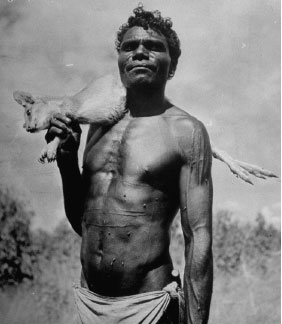
We may not eat like him, but we still function like him!

I've read several articles in the past year and a half about how our we get fat. I've forgotten most of what I read but I didn't miss the bigger picture: our bodies have a lot of different ways to get fat. There's easily a half-dozen hormones that could be released that trigger the growth of blubber. Maybe more. The take-away lesson: Every body loves fat and it does anything it can to get it! That's why arguing about low calorie vs. low carb dieting is pointless. High calorie diets will make you fat. So will high carb diets. Fat is the body's energy bank account when the food runs away or dies off for the season. Look around outside if the leaves are falling off the trees where you live: every animal's doing everything it can to get fat! We used to have to do that too. Our body hasn't gotten the memo. It's still trying to do everything it can to get fat.

This also dispels another, bullshit notion: being fat is genetic. Well, not exactly. It might be genetic, yes. Thing is: WE'RE ALL DESIGNED TO GET FAT!

We can't leave out movement either. Face it: too many of us don't move enough. I guess the modern world assumed that after working ourselves to death (which we don't do these days... NOT BY A LONGSHOT!) by our mid 40's for the first 10,000 years of our existence, life would be heaven... if. we. barely. moved. at. all. We move so little that we seemed to have forgotten how to move properly. So, when the sedentary decide that it's a damn-good time to start moving, they turn to... I can understand why most people turn to some kind of long-slow distance running as a means of re-igniting the desire to move. It's one of the few activities that you don't really need anything to do. You don't need a machine or gear (although "they" have convinced a lot of people that they do!) to do it. There's just one problem: that's not what we were built to do! We've got two basic types of muscle: fast twitch and slow twitch. Many of us know this, and we know what they're all about. In case you don't...

Fast Twitch=powerful, intense, contractions. last no longer than 60 seconds
Slow Twitch=much less intense and powerful contractions. lasts for a long time.


There is no such thing as a medium twitch muscle fiber. When we were troglydtes, we journeyed over massive swaths of land over a period of days or weeks or we moved with great intensity for very brief periods of time. We weren't designed to move kinda fast for sort-of long periods of time. The first Marathon runner died after he finished. So, if you're new (again) to moving remember this when you exercise: move in a strong, intense manner or move very, very slowly. Forget the in-between shit!

While you're strength training keep this in mind too: if you're trying to get as strong as possible, you're failing. No, really... you're probably not even using a fraction of your muscle power. That's what you don't hear about much when discussing different types of strength: absolute strength. We only contract our muscles with a fraction of it's full-force potential. The mind only releases this extra power when it senses a life-or-death need to do so. Releasing this kind of power usually injures tendons and ligaments. This explains the mom picking up the car stories... or The Mighty Atom. Or, as so wonderfully chronicled in the Discovery Channel in The Human Body: Pushing the Limits(<----THIS IS A HINT...BUY THIS!!! ),the story of the guy who pushed a 1,000 lbs rock off his chest to avoid being simultaneously crushed and thrown off a cliff...

Let's just play devil's advocate for a moment: what if you could? When the mind senses a need, it will force the body to do it's bidding. That guy who threw the boulder off his chest tore some muscles up and gave himself the mother lode of tendinitis doing so. Compared to dying, that's a fair trade-off. Is getting a too-big weight off the ground, with the same results, for the sake of pride a worthwhile trade-off?

We can verify a lot of conclusions about how our body works by examining why it would need to work that way. Even as we advance our technology and modify the relationship between ourselves and our environment, we need to keep in mind that our past is still alive and well within our bodies, regardless of whether or not these adaptations serve a purpose or not anymore. One thing that we haven't been able to bend to our will is our body's function and regardless of what many say, science doesn't hold any promise of changing that. We still have to adapt our behavior to our bodies.

Wednesday, November 17, 2010

The Death Walk

Is it called a duck walk or an elephant walk? Since I'm out here in the world, strength training usually not in a gym and almost always alone, I don't know what some people may have dubbed certain exercise moves. I figured someone must have grabbed onto the ends of a sandbag, picked it up, and walked with the bag at knee-level before I thought of it. I just had never heard of anyone doing it, or what they might call it. So, I figured that the elephant walk would be as good of a name as any. David Lemanczyk informed me that, in Strongman, it's referred to as the duck walk. He did agree with my thought that "elephant," sounded much more cool and tough tough than, "duck."

Dave's one of those guys you just don't want to believe when he shows up on a forum board. 6'3", 200-whatever pound guy who works out with a 170 lbs sandbag, can partially squat 1,000 lbs, and can do a one mile, 100 lbs sandbag carry in about 15 minutes? Yeah, WHATEVER... JUST LIKE EVERY OTHER, LYING, FUCKING GEEK 17 YEAR OLD WUSSY ON THE FORUMS! A closer review of his web site and his youtube page reveals...

Dave lemanczyk is a 6'3" 200-whatever-lbs guy who works out with a 170 lbs sand bag, can partially squat 1,000 lbs, and can carry a 100 lbs sandbag one mile in about 15 minutes. No keyboard-warrior here!

Anyway, Dave reported doing this on Rosstraining about a week ago and it really inspired me. As you've probably noticed, I've really gotten into working out with sandbags lately. I've done a lot of carry work with them but usually preceded by some sort of squat work, usually a Zercher squat to zercher carry. By the time I'm getting to walking with the sandbag, my upper back and arms are half-gone from holding the bag, cutting back on how far I can carry the sandbag. I usually only go 50-60 paces.

Dave put the idea in my head to do some sort of longer-distance carry work-only. If you haven't figured it out, I'm kind of opinionated and I'm a strong individualist who likes to do things my way. Besides, I couldn't decide HOW I wanted to do a long-distance sandbag, farmer's walk. There are a lot of ways to hold a sandbag. I have the problem with choosing ice cream flavors too. I decided to take the same route that I do with ice cream: all of them.

That's how I came up with this workout that decided to give an even-cooler appellation: the death walk. I do this workout on weekends when I'm killing time at work. The job site that I'm working on has a circular driveway that measures in at 210 paces, one time around. So, every time I went around, I did a different walk with the sandbag, alternating between the easier ones and the harder ones. This isn't too hard to determine: farmer's walks that place the weight over the spine, closer to the body, and don't use the arms and grip as much are easier. Here's the batting order:

Across the Shoulders
Overhead
left shoulder
Elephant Walk
Right shoulder
Zercher
Across the Shoulders
Bear Hug

Obviously, the three easier carries are pretty self-explanatory. In the event that I'm double-labeling some of these, I'll explain further...

Overhead
This is probably the hardest of the bunch. Carrying a bag overhead really does a number on probably every muscle originating or inserting into the scapula. What's less obvious is the the incredible need for wrist and forearms stability while doing this. Plus, you can't get this one over with fast. Walk too fast and that bag gets harder to hold steady! No, you have to suck up the pain on this one and walk more deliberately.

Elephant Walk
While the Overhead might be the hardest, the Elephant is the most annoying. Trying to hold that bag at, or slightly above, the knee fries the biceps and the grip. Letting it fall below the knee dramatically shortens the length of your stride. Either way, the constant slam of your legs into the bag makes the bag move a lot, making your core work over-time. Did I say it was annoying? Too gentle of a description...IT'S FLAT-OUT MISERABLE!

Zercher
I'm going to keep up the tradition of calling any exercise with this arm positioning the Zercher. That way, I'm pretty certain everyone will know what I'm talking about. Either way, this is a good one for the biceps and the Traps, UPPER, MID, AND LOWER!

Regardless of the way that the sandbag is carried, I find that I get the most out of any of them by trying my damnest to maintain proper posture as much as possible. This detail makes every sandbag walk, no matter how "easy"... hard work! No sagging shoulders, bent wrists, or slouching under the weight! It's also probably a good idea for your overall health. If posture can't be maintained, then a lightened sandbag might be in the order. In my not-humble, not-professional opinion, You should use a sandbag that's borderline-really-fucking-difficult to carry for two minutes.

This is the kind of conditioning work that I like doing the most. Carrying a heavy, awkward object has got to be the epitome of the often abused-misused term, "real world functional strength." I have to take my hat of to Dave-L for giving me the kick in the ass to realize that carry work with the sandbag can be an awesome workout, all on it's own.

Monday, November 8, 2010

The Best

Always be on the lookout for knowledge. You never know where you’re going to find it and it’s also surprising how you can find something useful about one issue when looking for answers to something entirely different. Several weeks ago, I was in church listening to the priest talk about the latest gospel. Among the things that he mentioned, he talked about being good enough for God’s standards and how the effort to be the best at earthly things often times ran contradictory to the goal of being the person that God wants us to be.

These words hit me quite differently two weeks later. My wife and I took my grandmother to see her sister in upstate New York. My wife felt like driving, which bored me to tears. Everyone was still tired from waking up so early so with nothing to do but sit silently and get car sick from my wife’s driving (no easy task), I picked up the latest issue of Muscle and Fitness out of sheer boredom. The latest issue discussed the training of the stars of the Expendables. Actually, it only discussed the physically largest stars of the Expendables: Stallone, Dolph Lundren, Randy Couture, and Terry Lewis. The writers of the article took the time to dead-pan the cast of “300” as merely 175 lbs actors with body paint.
Guys who look like they could kill 25 people
The next article afterwards was a very interesting juxtaposition: Real life war heroes. Real life “Expendables.” Of course, none of these Expendables looked liked the previous, fictional “Expendables.”
Guy who actually did kill 25 people!
That's when something occured to me. A lot of the training that people do is to be the best, or at least better. In theory, superlatives aren't subject to people's thoughts and feelings on the topic. That's not true though. We're unable to figure out for sure who was, or is, the best. Plus, defining the best would have to be based on criteria made by other people. There are a lot of man-made standards out there. Was Paul Anderson stronger than Matt Kroczaleski? Or is Ron Coleman way more powerful than both? It's hard to say since one was a powerlifter and the other did mostly Olympics lifting. Coleman is a bodybuilder.

That brings another question up: is that standard of strength that we're judged by worth meeting? Do we really want to take enough steroids to keep up with Coleman? Do warriors in battle need to be as imposing as Dolph Lundren to survive combat? Where does your health fit into this equation? Paul Anderson was a big, powerful man but live long enough to collect social security, something most people in the USA were. He was born with a kidney condition that doomed him but could he have hung around longer if he trained differently?

Being the best in these strength games are just that: games. I'm not trying to say that's a bad thing. Certainly I'd think it's a more constructive use of time to lift big, heavy shit than to waste time on the internet arrogantly talking-up how tough you are or playing GI Joe-like strongman comparison's. At the end of the day, it's all exercise, something that most in Western society sorely lack these days too.

Let's not confuse games' overall worth in our lives. The games we play, and the training we do, should be to fulfill ourselves, be it emotionally or physically. Things go wrong when we seek a sense of fulfillment from others.

..."and may the god of your choice bless you!"

Sunday, October 31, 2010

A different look at old-age strength trainers

Every once in a while, I'm sure that many of us found something on the Internet relating to some sort of magnificent physical achievement accomplished by... AN OLD PERSON. Maybe it was that newsletter mentioning how John Grimek was doing 400 (or was it 500?) lbs squats for 20 reps at age 80. Or, how about that time that you found Built Old Lady rolling up an aluminum frying pan on youtube. Maybe it was seeing Sylvester Stallone still ripped to shreds at the SSI-check age. Perhaps it was Clarence Bass putting Sly to shame at age 70.
Yeah, I can barely believe it either!

For most of us who train in intense movement, we can't help but be awed by such a lasting display of physical prowess displayed by people who bury their fingers up to their knuckles in Father Time's eyes. Only the statues that such people model for are supposed to last that long, not the models themselves.

Indeed, most societies brand the people who've passed into, and beyond, middle age as frail and weak. We all know the narrative, along with the age-related degenerative diseases, medicines, surgeries, procedures that rob the body of what remains of it's strength, health and physical vitality. Defiance of all of that is bad-ass for sure. So, softer members of said societies are prone to label such rebels as a bit crazy.

That might be true. After all, being labeled crazy because you're a rebel is half of the fun of being a rebel in the first place. Okay, that's how the culture sees people who follow dudes like Jack Lalanne. Inside of our sub-culture, I started thinking it as a call to moderation.
I'm sure we all know people like this: acquaintances who told us about how brutally- bad-ass they used to train, how low their BF% was, the 10 hours a week in the gym, etc. The only trouble is, that was also several years ago and now they're out-of-shape. I think that we just spelled, "burned out." I'm left wondering why they worked out so, damn hard so regularly? What was the rush? A large reason for training goals is to reach a state of transcendence but when it comes to all matters of the body, that doesn't happen overnight.

One thing that I think that we can glean from the silver-haired ironheads is a realization that there isn't a huge-ass rush to get sick-strong. There's no need to put the foot to the gas and redline the engine every time we touch foot in our prospective strength shrines. We may have more time to do amazing things than we realize. The notion that only happens in the 20's and 30's is probably a figment of our culture's collective imagination.

There's a good saying that goes something like, "Make haste slowly." Sure, I love a brutal work out pretty regularly. At the same time, I'm realize that the bigger picture: to be able to do this stuff for a long, long time. I won't get there if I burn myself out by going full power, full time. Clarence Bass and Jack Lalanne never did. It goes back to what I've said before: it's easier to fix undertraining than it is to fix overtraining.

Oh, the old lady with the frying pan...

Saturday, October 16, 2010

Forearms, Hands, Fingers and Push-ups

One thing that I've always stressed since I started blogging is that there are other ways to make strength training harder than by incremental weight increase on the resistance you're working against. Resistance, and level of difficulty, can be increased in a lot of different ways. Accepting this fact and exploring it further is how we can get stronger without constantly needing to be tethered to an increasingly large source of iron to get strong.

Push-ups and Pull-ups, of all size, shape and flavor, are the staple exercises for upper body strength training for BW aficionados. A lot of us could work the most basic, vanilla, and well-known pulls & chins for a while before we get to the point of needing modifications to make them harder. The former needs changes sooner. Both of them can be made more difficult by a simple change: add an element of grip, finger and/or forearms training to them.

The hands are really, really important to our body. I know that sounds like a no-brainer but I don't think we really realize the extent. Our hands are packed full of nerves and sensors. A really hilarious series of pictures are out there. They take into account how many sensors there are in various body parts and relates them to size. The hands are very small in relation to, say, the arms and chest. Yet, they have many times more nerves and sensors. So, if we were to scale the hands up in size in relation to the number of nervous system stuff in them, we might look something like this...
How we can relate this information to making push-ups, pulls & chins harder is easy to understand with a simple test that you can do right now. Make a fist in front of your body and squeeze...REALLY! FUCKING! HARD! Notice how your entire arm, shoulder and chest contracted really hard? Do the same thing but now put your arm overhead. Note your back muscles.

There's also another, easier way to relate why throwing hand work into your push-ups and pull & chin work makes them harder: instability. Where you used to have a nice, solid and stable closed chain exercise, now you have reduced the amount of contact that you have with the object you're pulling yourself up to or the floor you're lowering yourself down to. When you train with a compromised grip, the whole notion of flying through the eccentric part of the exercise for the sake of making it easier is over. Now you actually have to focus, rather than drop through it!

Okay, so the next step would be adding this into the workout. Pull-ups and chin-ups are far more straightforward for grip training. Grip is such an integral part of the exercise already. All you have to do is find something else that's much harder to grip than a 1" thick bar that everyone seems to use. Towels are a prime candidate. You could grip two towels, wrap a towel around your bar to thicken it up, or take a thick towel and grasp both sides of it. Add to the insanity by supinating the grip when you do the pull-up.
Just a sampling of the stuff you can grab onto rather than a pull-up bar
The answers for push-ups aren't as obvious, and frankly the easiest probably scares the shit out of a lot of people: do push-ups on your fingers. It's easy to understand why because this is brutal on the hands and fingers. Still, it works so, damn well, so grow a set already! If this is too crazy for you, you could always elevate your upper body by doing fingertip push-ups on some sort of blocks. This will drop some of the upper body weight off your hands and get you used to the exercise. For those of you who bang out lots of fingertip push-ups without a whole lot of effort, do the opposite: place your feet on some sort of block, a chair or a bench. Don't ignore the fingertip treatment for your other push-ups. Jack Lalanne used to do superman push-ups on his fingers. I've started doing fingertip handstand push-ups...


One step up in difficulty would be doing your push-ups on one hand... or should I say, five fingers...

Another option for push-ups would be to find a welder near where you live and show him this picture....
FYI, if you buy these from this guy, you're dumber than the people buying Shake Weights!

Anyone with a band saw, a drill and a stick welder could easily make you a pair of these for a dirt cheap price, probably in about 10 minutes, and that's stopping to have a beer after making the first! They're really hard on the grip though! Just do me a favor and under no circumstances buy these from anyone online! You're just getting ripped off if you do so! Well, these and these are a little more reasonable...

Oh, and of course you'll get really strong hands, fingers and grip if you keep training like this. That's the most obvious benefit to this sort of training. What I wanted people to note is that throwing in some grip training into your workouts does a lot more for your body than just make people fear your handshake.

Friday, October 15, 2010

Write this way, train this way, be this way

My body surrounds a brain that often times has a hard time accepting compliments. For some inexplicable reason, I can't shake the notion that I'm being patronized. One compliment that has managed to out-run the suspicion-guard-dogs, to be accepted as a genuine compliment, is that I write well. I've heard it enough and after reviewing the stats here at BWF's Cent-Com, well, there can't be that many people lying.

Yeah, there are other insecure thoughts that roll around in my head. Another involves my writing as well. More specifically, when I read a blog of a friend. Too often, I read and while I admire how well this fellow-blogger writes, I also wish I could write as well as they do. Or, maybe a better, more accurate way to say it: I wish I could write in that style...that well.

Insecurity is why this sub-culture thrives. Sure, there are some of us driven to get strong for other reasons other than feelings of not being good enough. I'll put good money that some insecurity rooted in physical inadequacy pushes most guys into the gym.
He made a lot of guys show up in gyms, including rich nobles who had a, "lack of vigeur"...if you know what I mean
Some of us were blessed with the ideal blend of genetics, environment, food and rest, plus physical stimulation to build an awesome, powerful and fearsome body.

I should have hit the jackpot on that lottery. My father's lack of interest in training may render him overweight but he's still, and aways has been, a very powerfully-built man. I had part of the right genes. I lived, ate, slept and worked sort of like him too. I should have had a decent shot at getting his thick-wristed arms that, to this day, can tighten bolts so hard that I swear they were put on with an air-compressed tool...
... But it didn't quite work out that way. I tried. I doubt I'll ever quite get there but looking back on my 2007 mass-building experiment was that I (generally) enjoyed the struggle. It was nice, for once, to be growing muscle. I didn't end up looking like I had envisioned but I was happy with the results (but clothes shopping always sucks, and I needed to buy a lot of new clothes!).

We don't all look the same any more than we write or perform alike. Unique, like everyone else. That must be kept in mind when training. That's why one prospers on a program where another fails. I don't think that insecurity is always a bad thing. I see it as the soul's way of saying that there's weakness that needs correction. Individuality ultimately prevails though and we can't let insecurity force us into a body, action, or even writing style that isn't made for us. It drains the fun out of the persuit and it's ultimately counter-productive to the ultimate goal of making a better overall human being.

Wednesday, October 13, 2010

The Zercher Squat: All kinds of Awesome!

If you spend enough time in improvise mode when you train, there are certain exercises that will seem to pop up regularly in your repertoire. It's hard to beat one arm push-ups, single leg squat work, or some sort of planking when the ability to go to a proper place of fitness diminishes. That's the BW-side of strength training. When I decide to start picking up stuff to get strong, then it's really hard to not stop Zercher squatting.
It's called a pump rotor. Approximately 4" diameter, solid steel. Weight: about 160 lbs
The reason's pretty simple: you can zercher squat just about any object that will fit in the crooks of your elbows. Sandbags, rocks, barbells, odd stuff, or heavy pipe can be Zerchered. Plus, you don't need to lift nearly as heavy an object with the Zercher to get a challenge since the object being lifted is in front of the back rather than directly over it.
The practicality of the Zercher squat doesn't end there. The human body is capable of lifting stupid amounts of weight with the back squat but how much heavy shit do you really pick up land put down like that in real life? Most often, the said pain-in-the-ass heavy object that needs moving is going to be in front of the body, not above it, nicely put in position with the help of some sort of rack. Life's rarely that convenient. No, you're going to grab it in a manner that looks sort of like (although not exactly the same) as a Zercher Squat.
The Zercher's also a lot more of a full-body exercise than many of the other squat variations too. The arms and the upper back muscles really get pulled into the torture session. The abs are also pulling some major overtime here too since they've got to stabilize the spine. I also find this squat variation a lot easier to go ass-to-grass (ATG) on this one, if you're into that.
By the time I got around to taking this picture, I wasn't that into ATG!

What I think that I love most about the Zercher Squat is that it works so well in conjunction with farmer's walking. As soon as I finish up my squatting, I just start walking with the weight (usually the sandbag) in my arms, cradling my little bundle of miserable joy! It's a brutal combination!
It makes sense that the Zercher is so awesomely convenient. Ed Zercher's workout area, according to straighttothebar.com looked as much like a scrapyard as it did a gym. Zercher regularly trained with oddball pieces of steel that he picked up here and there. Clearly, he was one of a few strongmen who relied very heavily on improvising. With strongman and the whole "old is new" mentality out there amongst strength trainers, The Zercher Squat offers a perfect blend of practicality and performance. Give it a try and you won't be disappointed.

Good description of Zercher execution