Pull-ups are like rope climbing right? Is there a pull-up that I can do that's like a rope climb?
Occasionally, and invariably, I get questions like this. Rope climbing could lay claim to being the ultimate in upper-body, BW pulling training. It's just brutally hard in all kinds of awesome ways. Frankly, these ways aren't shared with just about every pull-up variation you can do. You can't make a pull-up effectively simulate a rope climb just because you do it while gripping ropes. It doesn't matter that they're working the same muscle groups. That's like saying that dips and push-ups are the same, and equally good for chest development.
So what are those awesome ways that make rope work more of an upper body strengthener than most pull-ups ever thought of being?
1. Remember a while back where I talked about most exercises being one concentric movement followed by an eccentric movement? Well, the rope turns that one on its ear. You're doing one concentric contraction after another until you get to the top of the rope. Then, it's all eccentric on the way down. In other words, there's no way to cheat on this one by rescinding control of the eccentric part of the exercise.
2. Why is that? Well, DUH! You're on a rope, probably 10-25 feet off the ground! The power of your muscles is the only thing that stands between you and a shattered tailbone and busted knees. There is a life-or-death quality to rope climbing that forces you to get every last bit of strength out of your upper body pull muscles.
3. With most pull-ups(except one-handed, of course), there's two hands in contact with whatever it is you're grabbing. Sure, there are plyo versions but when you're done exploding, you're back to two hands. With ropes, you alternate between two hands and one hand.
Okay, while all of this is awesomeness makes for a brutal method of training, it's not available to everyone, or even for everyone. It's not for people afraid of heights or weak on pull-ups to begin with. Most of us probably don't have the ability to set up a rope either. So, in the spirit of my blog, we won't cry about what we don't have. We'll just find ways to make do.
So, how do we get reasonably close to a rope climb with a pull-up? While the First two points about rope climbing don't lend themselves to easy and obvious substitutes in the pull-up arena, the last point does. People have been switching grips during pull-up for a while. Here's a video from a fellow Vermonter, Matt, doing one such variation...
Yes, he's spending some time hanging one-handed from the bars but it's all from a dead hang. If we want to get closer to the rope, then we need to hang one handed like we would on the rope. That means hanging one handed at the top of the bar. Now, we're getting somewhere. I've tried this variation on the switching grip theme a few times and as far as I'm concerned, this is as close as a pull-up can get to replicating the rope climb experience.
I'm getting that superhuman-wannabe bug and becoming increasingly unable to do things simple or easy, even on my first time. I started out using a thick bar (aka the frame of my monkey bars) with two towels. Switching between thick grip and towel pull-ups proved to be all kinds of brutal on the grip and the biceps... and the calluses too. For anyone who follows the Facebook page, this is how I tore my calluses off my hand.
With this style of pull-ups, I don't get too concerned with form. Switching grip at the top of the movement makes things get a bit sloppy. Even four pull-ups to a set of these are pretty brutal. Besides, nobody critiques form on rope climbing, right?
This modest adjustment to this old pull-up theme should make for a nice progression between pull-ups and rope work. It also makes for a decent substitute if you don't have rope climbing capabilities. Just do your hands and elbows a favor and don't do what I did. Start modestly and work up to the harder stuff. It's always easier to fix undertraining than it is to fix overtraining.
...and check out Matt's place sometime!
Thursday, August 4, 2011

Heat
It's been a while, I know. Life's moving fast and hard lately, taking up precious time and brain power where frivolities of writing things that don't make money have taken a back seat. Still, there are times in the weekend where Henry doesn't have colic that needs to be soothed and the drains in the yard don't need to be dug up and I can enjoy life.
One of those times was last weekend where I attended a wedding reception for some friends who got married in Peru. For those of us unfortunate who couldn't make the trek south to attend, they threw another party for us here. The groom is one of my periodic readers and he ambushed me at the buffet line to tell me about how he wants to work out but the damn heat in Miami (where he was living) was so brutal that he just couldn't bring himself to keep doing it.
Not at my most thought-provoking, I came up with the pretty boiler-plate, hardcore answer. Since I don't approach training with a soft touch, I let him know that I'm not the guy to come to and say that you can't deal with the heat. He must have expected that and said something like, "So, I should stop being a pussy and suck it up?" My reply? YES!
While there is a lot of truth in such an exchange, on reflecting on it there's more to it than a sophomoric and tough-guy answer. Yes, dealing with heat is largely mental. Most of us aren't football players wearing north of a dozen pounds of gear in the searing heat. So, we don't really need to worry about dying from heat stroke like the news tries to scare us into worrying about every time the thermometer hits 90 degrees. So, a large part of working out in the heat is just accepting that we're going to be hot and sweaty. It's just another factor that we have to learn to overcome, just like we learned to accept the intensity of real strength training.
There are other mental elements in play however. Most of us deal better with things when we plan for them. Physically, there is a possibility that the heat might make us sick. Our mind knows this. If we plan for the rigor of working out, then we'll be a lot more adept to accepting them. Hydration is absolutely paramount to training at the top end of the mercury. That doesn't just mean that we have water handy when we're working out. You need to keep water in your system all of the time. Its true that you can be dehydrated without even knowing it. You'll figure this out when you go to work out and you just can't move like you did if you were adequately hydrated before even starting.
Notice that I said WATER and didn't mention any other form of beverages. People drink way too many other things than water and most of them don't help you stay hydrated any better than water does. Frankly, some of them are far worse. I make one exception to this rule: coconut water. This is a soft drink that I'm glad to see catching on. I've been a fan for three years. A little sip (and by sip, I mean around 4 ounces) here and there during some extended periods of time in the heat really helps deal with the electrolyte loss.
Another piece of the mind games of training that might have skipped a turn is what many of us decide to do in that heat. I hope that most of my readers would be just as repulsed as I am about running on a treadmill while watching TV. If that's not the case, and we crap out from doing such an activity then I'm hardly surprised. I recall hearing a theory put out by (I think) Pavel that doing sets of 20 reps is inferior to doing sets of 5 because the heavier weight (or more intense move) encourages more intense concentration. While I totally disagree with this rendition of using the exercise to focus the mind, I do agree that certain forms of training demand so much focus that the mind will not have the luxury of thinking about other things, including the heat. Let's face it: there are too many methods of exercise that are distracted by design and when additional stresses are introduced, failure is inevitable. Choose your exercises wisely.
Mankind has used heat to cook for millenia. Cooking is a good way to get rid of the things in food that shouldn't be there (attention raw foodies: this is a metaphor, so bear with me). It's funny that heat does the same thing with training too. You're going to find out what you should be doing and what you need to drop by working out in the heat. You're also going to discover if you're treating your body right by getting into the human pressure cooker known as your respective gym more often. As far as I'm concerned, there is an awful lot of good that can come out of training in the heat. It's form of stress that teaches a lot of good lessons, if we all can get around to suppressing our inner pussy and do it.
Saturday, July 9, 2011
Tendon Strength? Maybe Just Slow Down a Little!
It should have been here yesterday, right? We're a subculture within a larger culture that can't stand things that don't happen right now, if not earlier. Waiting for a stubborn body to meet the goal that we set for it is the strength training equivalent of Dial-up AOL. It's got to happen and it better happen sooner rather than later, right?
As I walked through Dicks Sporting goods, I notice an effort to bring tools formerly reserved for our out-of-mainstream, semi-underground movement percolating to the surface. It's not just our tools either but also some of our ideas and beliefs around training. One such idea I've seen and heard passed around lately revolves around tendons and ligaments, particularly around strengthening them.
That's a good thing, I guess. These are just as much a part of the strength picture as the meat that we use to propel our bones. They're attached to tendons, so that makes sense to give them some consideration when we train.
The question then becomes what kind of consideration? How do we strengthen our connective tissue? That's where I break from the old school. I've never given an ounce of thought concerning the strength of my tendons or my ligaments. I've never done any special exercises for them. Yet, I've had no problems with them when training.
So, the idea of doing tendon-strengthening exercises never appealed to me and after cracking open some books on the topic, the reason became very clear to me. Tendons (and ligaments) are made up mostly of collagen that's arranged in a fiber-like and parallel manner. What lept out at me is that, unlike muscle, they're poorly vascularized and innervated. Without these, they recover much more slowly since they depend on absorbing nutrients from things surrounding them.
It appears to me that answer to keeping these bone connectors and organic springs in decent shape was to buck the urge to force the muscles to do things faster than the blessed meat strings can keep up with. I've never had a problem with waiting months to see a goal come to fruition and I think that's why I have never had an issue with anything resembling tendinitis. From what I've heard, that's a nasty, NASTY problem that only has one solution: time to heal. No exercise. Does that really sound good to anyone?
So, from where I'm standing, patience is what these rarely thought of chunks of protein really need to get strong. Not only do they need it, but they demand it... and they will get it! Either we will take the time to let them get strong or we will take the time to let them heal. Think about it this way: our tendons are the little brother/sister of our muscles. Many of us were obliged, or otherwise forced, to take our smaller siblings along for play time even if they slowed us down. It's the same sort of scenario here.
Sunday, July 3, 2011
Weighty Matters: Combining Weights and Calisthenics
It doesn't matter where you strike up the conversation. It could be in the internet or in real life. Either way, whenever the subject of weights vs bodyweight comes up, someone eventually takes the middle ground and says something to the effect of, "why not do weighted calisthenics? There's no need to argue when you can combine the best of both worlds. There's no rule book that says it's not BW if there's added weight."
Okay, let's compromise! There's been enough bickering about the whole weights vs. BW. Let's all be friends and talk about weighted Calisthenics. Generally, two exercises get the call when it comes to adding weight: Dips and pull-ups. There are others you can do, of course, but these two are the most accepting of using a wider array of weighted material to do the exercise since you hang to execute them, thus creating lots of open space around you.
So, we've got our base exercises to weigh down. The question now is: with what? There are a lot of different things that you can use to add weight to calisthenics. the most common are:
Over the past year and a half, I've had the opportunity...wait, not the right choice of words...I've been forced to improvise and use all but the weighted vest. They're not all the same and each one has its benefits and drawbacks, so I'll go over them one at a time, based on my experiences.

Backpacks
This is, without a doubt, the cheapest way to get into weighted calisthenics, if you already have a pretty durable backpack. You can throw weight plates or bags of sand (whichever you have handy) into the bag and get going. Backpacks are an easier weight to pull or dip with. I'm tempted to talk about leverage in relation to weight distributions but since I always seem to stick at least half of my foot in my mouth with such talk, I'll just say this: Something about the weight placed on the back feels easier to me. So, if you're looking to progress with more weight, you're probably going to hit a wall. For most backpacks, it's going to be difficult to get much more than 75 lbs in the bag and still have the bag hold up to the load. Of course, that just means that you need to find another way to make the exercise harder. I did a lot of my famous towel pull-ups with my 40 lbs tool backpack. I didn't miss not having an extra 15-20 lbs back there!
Dip Belts
Probably the most common tool to do weighed dips and pull-ups and for good reason. If putting lots and lots of weight on your dips,pulls and chins is your game, then you need a dip belt. You just can't get as much weight onto your pulls and dips with any other tool as you can with a dip belt. Reasonably inexpensive (if you already have the weights), cheap and easy to make one of your own and capable of using several different pieces of weight (plates and kettlebells being the most common), this would make the most sense for weighted calisthenics. I also notice that the weight dangling between the legs makes the exercise harder than loading it on the back. So, you get more work out of the weight this way. Plus, this method is also reasonably comfortable, even with a lot of weight.

Chains
For sheer versatility, chains completely blow everything else out of the water. You can use them so many different ways (make necklaces, bandoleers, or make a dip belt out of it, if you have the right fasteners) in addition to using them on barbells for squat, deadlift and overhead work. If you make a chain bandoleer, push-ups become an option for weighted calisthenic work too! I don't know how much self-image plays into your training but if you want to look like the most hardcore, Metallica-blaring, raw-meat eating muthafucka' in your gym, then chained calisthenics are the way to go! It just looks flat-out cool to work with them!

As cool as they look, chains were made to tie machinery down and lift machinery up. They weren't made to be worn and there's the rub (literally) with chains: they're not comfortable to work with. You might want to add towels for padding and keep your shirt on. It's not like anyone wanted to see your chest that badly anyway (unless you happen to be a young woman). Strike two with chains is that they are expensive. If you're one of those people who figures out the cost per lbs of your weights, then chains will give your cheap bastard heart an attack. While it's cheaper to buy smaller diameter chain, it's also easier to tangle up. NOT FUN! The big stuff can be purchased at rigging or trailer supply stores but like I said, it's expensive! I personally like the 1/2" chain the most. It's a good blend of weight, price, and ease of use. If you go this route, go for what's called Grade 30 or Grade 40 (sometimes called grade 3 or 4 as well). It's a lot cheaper than the higher grades (Grade 80, used for lifting tens of thousands of pounds overhead. You obviously don't need to pay extra for this kind of durability if all you're using it for is weight).
Dumbbells
I've used dumbbells (and dumbbell-like objects) with dips, pulls and chins quite a bit. All you've got to do is pinch the handle in between your legs, either just below the knees or the ankles. Then, pull or dip.
I made it sound easy, didn't I? While this is very simple, and accessible if you have dumbbells already, it's also very hard to do. In fact, putting a dumbbell between the legs while pulling or dipping is probably the hardest position I've found when adding weight. So, it doesn't take a lot of weight to add some serious challenge to the movement. It'll also throw some leg work into these primarily upper body movements. Talk about confusing muscles!
Is the downside that you need a partner to put the dumbbell in between your legs? Not necessarily so. A few nights ago, I was playing around with dips with a flanged piece of 8" ductile iron pipe. Standing this chunk of iron on the ground, I'd lower myself down, grab the pipe in between my legs, and proceed on with the dips. When I finished, I'd lower myself back down and put the pipe back on the ground. I imagine that alternating between weighted and unweighted dips could be fun too!
What about the weighted vest? Eh. I've got a dip belt, my tool backpack, chains and a couple of dumbbells so I don't see the point. Besides, I've never really been impressed by them. Most weighted vests with any decent amount of weight cost a small fortune, even when compared to big-ass chain. In my not-humble and non-expert opinion, if one had a dip belt and some chain, there's no good reason to invest in the vest. The only advantage I see in them is that, unlike most of the others, they're actually made to be used with calisthenics. So, it's more comfortable but when do most of us care about comfort when we're training?
I recall a while back reading that sometime after he made his hundreds of millions of dollars convincing people that they needed a barrage of machines to make a strong body, Arthur Jones admitted that most people could take themselves to their absolute peak of upper body strength with just weighted dips and weighted pull-ups. Considering the source of the weight machine craze said this, it certainly carries some real weight. Had I just pulled a fast-one on the strength training public and made a fortune that my great-grandchildren couldn't possibly blow while doing it, I'd be very tempted to tell the truth too. You know, just to rub it in everyone's face!
Or, it shows that there really is room for compromise in our often-times uncompromising sub-culture.
Okay, let's compromise! There's been enough bickering about the whole weights vs. BW. Let's all be friends and talk about weighted Calisthenics. Generally, two exercises get the call when it comes to adding weight: Dips and pull-ups. There are others you can do, of course, but these two are the most accepting of using a wider array of weighted material to do the exercise since you hang to execute them, thus creating lots of open space around you.
So, we've got our base exercises to weigh down. The question now is: with what? There are a lot of different things that you can use to add weight to calisthenics. the most common are:
- Weighted Vests
- Dip Belts
- Chains
- Backpacks
- Dumbbells
Over the past year and a half, I've had the opportunity...wait, not the right choice of words...I've been forced to improvise and use all but the weighted vest. They're not all the same and each one has its benefits and drawbacks, so I'll go over them one at a time, based on my experiences.

Backpacks
This is, without a doubt, the cheapest way to get into weighted calisthenics, if you already have a pretty durable backpack. You can throw weight plates or bags of sand (whichever you have handy) into the bag and get going. Backpacks are an easier weight to pull or dip with. I'm tempted to talk about leverage in relation to weight distributions but since I always seem to stick at least half of my foot in my mouth with such talk, I'll just say this: Something about the weight placed on the back feels easier to me. So, if you're looking to progress with more weight, you're probably going to hit a wall. For most backpacks, it's going to be difficult to get much more than 75 lbs in the bag and still have the bag hold up to the load. Of course, that just means that you need to find another way to make the exercise harder. I did a lot of my famous towel pull-ups with my 40 lbs tool backpack. I didn't miss not having an extra 15-20 lbs back there!
Dip Belts
Probably the most common tool to do weighed dips and pull-ups and for good reason. If putting lots and lots of weight on your dips,pulls and chins is your game, then you need a dip belt. You just can't get as much weight onto your pulls and dips with any other tool as you can with a dip belt. Reasonably inexpensive (if you already have the weights), cheap and easy to make one of your own and capable of using several different pieces of weight (plates and kettlebells being the most common), this would make the most sense for weighted calisthenics. I also notice that the weight dangling between the legs makes the exercise harder than loading it on the back. So, you get more work out of the weight this way. Plus, this method is also reasonably comfortable, even with a lot of weight.

Chains
For sheer versatility, chains completely blow everything else out of the water. You can use them so many different ways (make necklaces, bandoleers, or make a dip belt out of it, if you have the right fasteners) in addition to using them on barbells for squat, deadlift and overhead work. If you make a chain bandoleer, push-ups become an option for weighted calisthenic work too! I don't know how much self-image plays into your training but if you want to look like the most hardcore, Metallica-blaring, raw-meat eating muthafucka' in your gym, then chained calisthenics are the way to go! It just looks flat-out cool to work with them!

As cool as they look, chains were made to tie machinery down and lift machinery up. They weren't made to be worn and there's the rub (literally) with chains: they're not comfortable to work with. You might want to add towels for padding and keep your shirt on. It's not like anyone wanted to see your chest that badly anyway (unless you happen to be a young woman). Strike two with chains is that they are expensive. If you're one of those people who figures out the cost per lbs of your weights, then chains will give your cheap bastard heart an attack. While it's cheaper to buy smaller diameter chain, it's also easier to tangle up. NOT FUN! The big stuff can be purchased at rigging or trailer supply stores but like I said, it's expensive! I personally like the 1/2" chain the most. It's a good blend of weight, price, and ease of use. If you go this route, go for what's called Grade 30 or Grade 40 (sometimes called grade 3 or 4 as well). It's a lot cheaper than the higher grades (Grade 80, used for lifting tens of thousands of pounds overhead. You obviously don't need to pay extra for this kind of durability if all you're using it for is weight).
Dumbbells
I've used dumbbells (and dumbbell-like objects) with dips, pulls and chins quite a bit. All you've got to do is pinch the handle in between your legs, either just below the knees or the ankles. Then, pull or dip.

I made it sound easy, didn't I? While this is very simple, and accessible if you have dumbbells already, it's also very hard to do. In fact, putting a dumbbell between the legs while pulling or dipping is probably the hardest position I've found when adding weight. So, it doesn't take a lot of weight to add some serious challenge to the movement. It'll also throw some leg work into these primarily upper body movements. Talk about confusing muscles!
Is the downside that you need a partner to put the dumbbell in between your legs? Not necessarily so. A few nights ago, I was playing around with dips with a flanged piece of 8" ductile iron pipe. Standing this chunk of iron on the ground, I'd lower myself down, grab the pipe in between my legs, and proceed on with the dips. When I finished, I'd lower myself back down and put the pipe back on the ground. I imagine that alternating between weighted and unweighted dips could be fun too!
What about the weighted vest? Eh. I've got a dip belt, my tool backpack, chains and a couple of dumbbells so I don't see the point. Besides, I've never really been impressed by them. Most weighted vests with any decent amount of weight cost a small fortune, even when compared to big-ass chain. In my not-humble and non-expert opinion, if one had a dip belt and some chain, there's no good reason to invest in the vest. The only advantage I see in them is that, unlike most of the others, they're actually made to be used with calisthenics. So, it's more comfortable but when do most of us care about comfort when we're training?
I recall a while back reading that sometime after he made his hundreds of millions of dollars convincing people that they needed a barrage of machines to make a strong body, Arthur Jones admitted that most people could take themselves to their absolute peak of upper body strength with just weighted dips and weighted pull-ups. Considering the source of the weight machine craze said this, it certainly carries some real weight. Had I just pulled a fast-one on the strength training public and made a fortune that my great-grandchildren couldn't possibly blow while doing it, I'd be very tempted to tell the truth too. You know, just to rub it in everyone's face!
Or, it shows that there really is room for compromise in our often-times uncompromising sub-culture.
Tuesday, June 28, 2011
Looking Back at the Back: More on The Traps
In keeping up with my cyber-narcissism, I watch the stats to see what's popular here at my blog. Yes, the whole bench press-push-up thing dominates my page view counter but another interesting post shows up as a perenneal favorite: Traps without Weights
How does that happen, just out of curiosity? I'm hardly the neckless, cobra-like trap-monster required to give out any advice about them in the first place. I won't say that mine are huge, but I guess they're good enough for people to accept my advice about them. So, if you're hungry for my advice and you think I show enough in the Trap department to make a comment on how to make them tough, then let's chat...

This glorious cut of meat is one of those things that lots of BW fanatics, or maybe just strength training fanatics in general, love so very much but whine about not having them while wondering how to get them. I have to bring up the dirty word around here first and foremost: genetics. Some people just hit the lottery with their fiber count and attachment points. My sister's fiance is a great example. He can barely find the motivation to hit the weights but he sports a pair of super-high, almost 300-monster-immortal-like upper trap muscle. BASTARD!

So, let's talk about us, less-gifted mortals. I could launch into some sort of anatomy lesson here like I did the last time I posted about the Trap but I'll spare you this. After all, I'm not a doctor, or an accredited anything, so I probably don't have any business lecturing about it. I think I have a practical mind though and when I look at the trapezius muscle and read about its actions that I come up with my own conclusion about what the traps are stuck on our back to do: they keep our shoulder blades in their proper place, relative to the spine. Sure, they assist in the rotation of the shoulder blades and they also shrug them but those are minor roles. The former is the action that we need to intitiat in our training.
Another, lesser-known fact about the traps is that they're made of more, slower twitch fibers. After all, keeping the shoulder blades in their proper place is a full-time job, not a fast-strong burst action. So, to make them strong, we probably need sets of reps that keep them working for 30-60 seconds. Both of these ideas explain why farmers walking with weight in the hands works so much better than more isolating shoulder shrugging. If there's a force shoving the shoulder blades downward or upward (overhead pressing or farmers walking), the trap has to kick in to keep those shoulders where they need to be.
These are weighted exercises of course. BW also has something to offer, it's just not as obvious. In my past entry, I noted that pull-ups activate the trap and I gave an isometric exercise as well. Extending the range of handstand push-ups can also call up the trap muscle in a big way. If this isn't feasible, then try doing it with pike push-ups. Either way, just get your head below your hands as much as possible!
Perhaps I should have mentioned this earlier. It's probably more important than the exercises for the trap in the first place: posture! Nothing you do in an hour at the gym will come close to making up for 8 hours a day spent like this:
 This would also explain why the better trainers are so adamant about fixing posture problems before looking to make the muscles more powerful.
Like I mentioned above, maybe I have no business talking about any of this. We choose this subculture where our body sells our message. No, I don't have humongous muscles behind my ears but of all of the aches, injuries and pains I've inflcited on myself, my shoulders have remained sound and strong. My trapezius muscle may not be as flashy but they sure as shit get the job done with minimal issues. What more could anyone ask for?
How does that happen, just out of curiosity? I'm hardly the neckless, cobra-like trap-monster required to give out any advice about them in the first place. I won't say that mine are huge, but I guess they're good enough for people to accept my advice about them. So, if you're hungry for my advice and you think I show enough in the Trap department to make a comment on how to make them tough, then let's chat...

This glorious cut of meat is one of those things that lots of BW fanatics, or maybe just strength training fanatics in general, love so very much but whine about not having them while wondering how to get them. I have to bring up the dirty word around here first and foremost: genetics. Some people just hit the lottery with their fiber count and attachment points. My sister's fiance is a great example. He can barely find the motivation to hit the weights but he sports a pair of super-high, almost 300-monster-immortal-like upper trap muscle. BASTARD!

So, let's talk about us, less-gifted mortals. I could launch into some sort of anatomy lesson here like I did the last time I posted about the Trap but I'll spare you this. After all, I'm not a doctor, or an accredited anything, so I probably don't have any business lecturing about it. I think I have a practical mind though and when I look at the trapezius muscle and read about its actions that I come up with my own conclusion about what the traps are stuck on our back to do: they keep our shoulder blades in their proper place, relative to the spine. Sure, they assist in the rotation of the shoulder blades and they also shrug them but those are minor roles. The former is the action that we need to intitiat in our training.
Another, lesser-known fact about the traps is that they're made of more, slower twitch fibers. After all, keeping the shoulder blades in their proper place is a full-time job, not a fast-strong burst action. So, to make them strong, we probably need sets of reps that keep them working for 30-60 seconds. Both of these ideas explain why farmers walking with weight in the hands works so much better than more isolating shoulder shrugging. If there's a force shoving the shoulder blades downward or upward (overhead pressing or farmers walking), the trap has to kick in to keep those shoulders where they need to be.
These are weighted exercises of course. BW also has something to offer, it's just not as obvious. In my past entry, I noted that pull-ups activate the trap and I gave an isometric exercise as well. Extending the range of handstand push-ups can also call up the trap muscle in a big way. If this isn't feasible, then try doing it with pike push-ups. Either way, just get your head below your hands as much as possible!
Perhaps I should have mentioned this earlier. It's probably more important than the exercises for the trap in the first place: posture! Nothing you do in an hour at the gym will come close to making up for 8 hours a day spent like this:
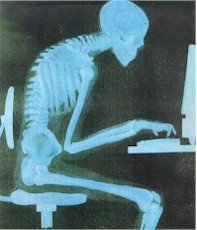 This would also explain why the better trainers are so adamant about fixing posture problems before looking to make the muscles more powerful.
Like I mentioned above, maybe I have no business talking about any of this. We choose this subculture where our body sells our message. No, I don't have humongous muscles behind my ears but of all of the aches, injuries and pains I've inflcited on myself, my shoulders have remained sound and strong. My trapezius muscle may not be as flashy but they sure as shit get the job done with minimal issues. What more could anyone ask for?
Saturday, June 25, 2011
Crushing the CoC's
I'm not sure you, or they, need a review of their flagship product by now. The Captains of Crush grippers are pretty well-known to a lot of subculturists. It's not like I need to tell you that they rock or that they're a first-class product. Still, if you come to my blog to see what I've been doing or what I think works or not, then this is what I think about the CoC's.
THEY DO ROCK!
I have no idea about the history of these style of grippers. Some random memory neuron in my mind recalls seeing one of these from the 1950s. Since a lot of fitness equipment follows the same trajectory into the mainstream, I guess that somewhere along the line, someone took this formerly-awesome gripper and then mass-produced it down to the plastic-handled jobby that my 3 week old son Henry could probably squeeze shut for 5 reps. We went from something that could make a strong grip to something that our girlfriends, terrified of having real muscle, could use to tone their forearms.
So, I never gave much thought to this tool. All it was to me was a junk-style exercise thing that showed up in the sporting goods department at K-mart.
Then, I had a change of heart. I decided to buy the Trainer and the #1 for the plane ride out to Sacramento. I had to get my work stuff and I figured that they might be something I could do when I'm driving back across the fruited plains as well. These things, when you count the shipping, run around $20-$25 each. There isn't much to them. They're an aluminum handle with a steel spring. There isn't much to screw up and make poorly and Ironmind doesn't screw them up. They are very nicely made! As you move up in difficulty, the springs stock increases in diameter. You might not even notice unless you put them side-to-side.
You will when you grip them! This was immediately fun! After burning into my mind that this genre of gripper was garbage, I was taken back. I even went overboard using things. Ironmind recommends using these things two or three times a week, treating this as seriously as any other workout you'd do. That's good advice to heed. By the time I hit Wyoming, my hands were ACHING.
That is the downside of this style of training, I guess. Furthermore, it's good to balance this out with some extension exercises. Ironmind knows how to sell stuff. They include in their instructions a plug for their glorified rubber bands. I prefer some sort of fingertip push-ups.
On the plus side, after I got rid of that new toy enthusiasm and started getting serious about using the CoC, I couldn't believe how well that these work. After two weeks of using these, I tacked on two more reps to my 3.5" thick bar pull-ups and three reps back onto my fingertip HSPU's and OAP's. I haven't had such a quick increase in grip strength since I took up rope climbing.
I started out being able to close the trainer but struggled with the #1. Now, I can close both reasonably easy so I bumped up to the #2. I'm not closing that one yet. I'm stuck at a partial close for time. I'll just enjoy the journey like I'm enjoying the CoC's.
Ironmind
Tuesday, June 21, 2011
Generation ROT!
40 Horsepower Electric Motor
The repair man and I stood before it in front of my truck. He looked at it nervously, asking me how we were going to get it into my pick-up truck. His face seemed to tighten up in a combination of what looked like equal parts fear and question. As he started to bend over to grab this sucker, I squatted down and rapidly scooped it up and gently placed it in my truck.
I lifted a 382 lbs electric motor???
Actually... no. I lifted the Variable Frequency Drive that controls the speed of the motor. For those of you not familiar with a VFD, it's basically a computer that runs Tesla's greatest gift to mankind, and it barely weighs 60 lbs. So, why in the hell was this kid, who has to be about my age, twisting himself up, questioning how the hell two men, supposedly at their physical peak, going to handle such a modest piece of equipment?
Welcome to Generation ROT!
This kid, physically speaking, was a tribute to our epoch of degeneration: Corn Syrup fattened with shoulders and a neck custom-destroyed to make out the slightest detail on any 1080p screen put in front of his face. All around me, I'm watching my peers wreck themselves at a rate that has some predicting my generation will be the first to live shorter lives than their parents in a long time. While we try to figure out how to enjoy the less time we have on earth, we're guaranteed to have a shit-storm of ailments brought on by this eat-shit-don't-do-shit way of life. No wonder everyone's treating 30 like it's old. How many of us 30 year olds are looking at ourselves in the mirror, knowing that our physical peak has gone by when in the back of our head, we know it should still be going on?
Seriously, professional athletes in most sports are at their absolute best between the ages of 27-32. There should be no fucking reason to treat this like the gateway of old age!
Nothing's getting better either. My wife had me watch Jamie Oliver's food revolution. It's downright fucking horrid how little people know, or even care, about what they eat anymore. With all due respect to Oliver's work (which I appreciate very much) if anyone gave a fuck, they'd figure out how to eat right on their own regardless if school taught them to or not. Never before in the history of humankind has more information been available on such a vast scale to even the youngest of our physically-degraded population. If they wanted to know, they'd could figure it out. It's all just a google search away!
Speaking of Google, I did a little experiment, typing in the following words and recording the number of hits. Maybe we can draw some conclusions about what information people most want to know about...
Eating right...39,300,000 results
Strength training: 54,300,000 results
Justin Bieber: 445,000,000 results
Free Porn: 394,000,000 results
Lady GaGa: 549,000,000 results
Selena Gomez: 194,000,000 results
Jersey Shore: 72,500,000 results
OWN: 4,080,000,000 results
Fat and sexy: 162,000,000 results
It's nice to see where our priorities lay...

It seems to me that what we care about most is being indifferent and lazy. People don't want to know and they don't even care that they're rotting on the inside. Hell, I see and hear the healthy and strong mocked as much as their messages are even given half-attention to. When you think about it, the extreme popularity of the plague driven, flesh-rotted zombie makes for a great mascot of generation ROT! This generation has descended into degraded bodies moving around with no sense of direction or control over themselves... they just want to eat!
 Some suggest that it's someone else's responsibility to wake up this pile of fatties and make them get into shape. Who exactly is supposed to do that? Maybe our pack-a-day, hen-pecked president who can't seem to stop face-fucking every fast food restaurant he can whenever he's away from Michelle? Or, maybe congress can do something about it.
 Then again maybe not. It doesn't seem like they know what the gym is supposed to be used for these days, do they?
Is this one too many cheap shots? Well, don't forget, this is the same bunch of clowns who subsidize the very crops that get our peeps fat, gave us that atrocious food pyramid guide to eat "healthy", and say that giving the kiddies chicken nuggets at school is perfectly alright. You know that's a short list too but let's face facts: no government anywhere has shown either the good judgement or the qualifications to feed a fucking sewer rat properly, say nothing about the future generation of degenerates expected to take their place!
If this is ever going to get better, then people need to WANT to do it for themselves... or be forced into it by necessity. That first option is hard but I can guarantee that the second one will suck even more. I don't expect one, angry blog rant to make any difference but at least I got this off of my chest. For now.
The repair man and I stood before it in front of my truck. He looked at it nervously, asking me how we were going to get it into my pick-up truck. His face seemed to tighten up in a combination of what looked like equal parts fear and question. As he started to bend over to grab this sucker, I squatted down and rapidly scooped it up and gently placed it in my truck.
I lifted a 382 lbs electric motor???
Actually... no. I lifted the Variable Frequency Drive that controls the speed of the motor. For those of you not familiar with a VFD, it's basically a computer that runs Tesla's greatest gift to mankind, and it barely weighs 60 lbs. So, why in the hell was this kid, who has to be about my age, twisting himself up, questioning how the hell two men, supposedly at their physical peak, going to handle such a modest piece of equipment?
Welcome to Generation ROT!
This kid, physically speaking, was a tribute to our epoch of degeneration: Corn Syrup fattened with shoulders and a neck custom-destroyed to make out the slightest detail on any 1080p screen put in front of his face. All around me, I'm watching my peers wreck themselves at a rate that has some predicting my generation will be the first to live shorter lives than their parents in a long time. While we try to figure out how to enjoy the less time we have on earth, we're guaranteed to have a shit-storm of ailments brought on by this eat-shit-don't-do-shit way of life. No wonder everyone's treating 30 like it's old. How many of us 30 year olds are looking at ourselves in the mirror, knowing that our physical peak has gone by when in the back of our head, we know it should still be going on?
Seriously, professional athletes in most sports are at their absolute best between the ages of 27-32. There should be no fucking reason to treat this like the gateway of old age!
Nothing's getting better either. My wife had me watch Jamie Oliver's food revolution. It's downright fucking horrid how little people know, or even care, about what they eat anymore. With all due respect to Oliver's work (which I appreciate very much) if anyone gave a fuck, they'd figure out how to eat right on their own regardless if school taught them to or not. Never before in the history of humankind has more information been available on such a vast scale to even the youngest of our physically-degraded population. If they wanted to know, they'd could figure it out. It's all just a google search away!
Speaking of Google, I did a little experiment, typing in the following words and recording the number of hits. Maybe we can draw some conclusions about what information people most want to know about...
Eating right...39,300,000 results
Strength training: 54,300,000 results
Justin Bieber: 445,000,000 results
Free Porn: 394,000,000 results
Lady GaGa: 549,000,000 results
Selena Gomez: 194,000,000 results
Jersey Shore: 72,500,000 results
OWN: 4,080,000,000 results
Fat and sexy: 162,000,000 results
It's nice to see where our priorities lay...

It seems to me that what we care about most is being indifferent and lazy. People don't want to know and they don't even care that they're rotting on the inside. Hell, I see and hear the healthy and strong mocked as much as their messages are even given half-attention to. When you think about it, the extreme popularity of the plague driven, flesh-rotted zombie makes for a great mascot of generation ROT! This generation has descended into degraded bodies moving around with no sense of direction or control over themselves... they just want to eat!
 Some suggest that it's someone else's responsibility to wake up this pile of fatties and make them get into shape. Who exactly is supposed to do that? Maybe our pack-a-day, hen-pecked president who can't seem to stop face-fucking every fast food restaurant he can whenever he's away from Michelle? Or, maybe congress can do something about it. Then again maybe not. It doesn't seem like they know what the gym is supposed to be used for these days, do they?
Is this one too many cheap shots? Well, don't forget, this is the same bunch of clowns who subsidize the very crops that get our peeps fat, gave us that atrocious food pyramid guide to eat "healthy", and say that giving the kiddies chicken nuggets at school is perfectly alright. You know that's a short list too but let's face facts: no government anywhere has shown either the good judgement or the qualifications to feed a fucking sewer rat properly, say nothing about the future generation of degenerates expected to take their place!
If this is ever going to get better, then people need to WANT to do it for themselves... or be forced into it by necessity. That first option is hard but I can guarantee that the second one will suck even more. I don't expect one, angry blog rant to make any difference but at least I got this off of my chest. For now.
Subscribe to:
Posts (Atom)