Monday, January 9, 2012

Training Wheels for Real Training

There are a lot of reasons why we all keep strength training. The most universal reasons that we all do it is the soul-moving qualities that come with overcoming hard, physical challenges. We also learn to appreciate the importance of being physically capable. Life just sucks when we're weak and that fact can only be avoided for so long. I could keep going on and on about why it's awesome to pursue physical strength for reasons beyond just the physical realm but smarter, more insightful people have poured over that in countless blog entries all over all of the internets. I do have a question though. It's one that a few of my Friends have taken up the keyboard for answers and action on the question at hand:
Why does real strength training have to be so gender-specific?

Indeed, there are no good answers to this question outside of a really fucked up notion of beauty that claims that any sort of real strength builder strike down the mere identity of women and render them men at the slightest touch of a pull-up bar or a barbbell. Anyone who cares to do some honest research into the topic, beyond Traci Anderson and women's fitness magazines, will realize this.

Now, I freely admit that my opening paragraph should apply equally to both sexes should be free from judgement about how someone will look when they train to excel. It shouldn't matter how a person looks nearly as much as it does...but that's the way that the cards have been dealt. It's the somewhat unfortunate fact of life.

The last time I wrote on this topic, I said the following:

Maybe that's what we should be doing to begin with here: promoting real strength training for real health for the sake of being able to do real-life movement. Then, after we've got that mastered, maybe we can all learn to appreciate a healthy, strong body and learn to find it desirable, maybe even attractive.


So, that leaves me with one thought. If the notion of promoting a look that looks like strong-health as attractive, then what would someone use? The thought that crossed my mind is: do most people even know what that looks like anymore?

I freely admit that there isn't usually a dramatic difference in how a strong woman and an ordinary woman look. There are tell-tale signs. There are things that you don't usually see on women who do some sort of real strength training. These are things that I don't think most people probably wouldn't find attractive. Using the notion that what's attractive is what's strong and healthy, I think that these are points that we can all agree on.

Let's start easy: the muffin top. While I'll freely admit that this is more diet-related than exercise-related, I've always maintained that good training is the ultimate feedback on how good your diet is. Five rounds of The Magic 50, Girondas 8x8, some a nice super-set of pull-ups and push-ups will tell you that your binge eating the day before was really stupid far faster than walking on any contraption ever would. That ultimately translates to a far better body. Besides, doing workouts like this for a sustained period of time won't allow for lots of body fat. To succeed at this stuff, you have to lean out!

Moving onto an actual show of muscle on a woman, I'd have to single out the skinny thighs. I think that men instinctively show off their upper bodies because they know that's what defines them as powerful men. Women have the power in the legs on a pound-for-pound basis more then men do. It's one of the few places where women can have some muscle definition and show it off without the "man" label. First image found on Google when I typed, "model legs".


So, there's no reason for women's legs to only meet at the knees. It could be said that it's actually incredibly feminine to have this display of strength on a woman!

Another, more subtle problem area that bothers me about women is the winged shouldler blades. How many times do we see this look on women...For some reason, ribs poking out the sides is prime tabloid material for actresses who are to skinny but this one somehow gets a pass. It's still bones sticking out of the skin where they shouldn't be sticking out! Furthermore, it's an unhealthy posture issue that begs for some stronger muscles in the right places.

I cringe to even bring up using attraction as a method of selling strength training to the other sex. Ever-changing notions of beauty have lead generations of women to do some very bizarre, and dangerously unhealthy things to their bodies. The reason why even mention it is that it worked so well for men 120 years ago.

I believe it was Lionel Strongfort who commented that for every person who wanted to be strong like Eugen Sandow, 20 just wanted to look like him. Indeed, if you do a Google Image search of Sandow, you'll find that most of the pictures of him out that exist have him showing off his body more than his lifting prowess. We can argue about the limitations of how much sex appeal should sell strength training all day but it's hard to deny that it works and it certainly has it's place. If anything, it's like training wheels: Something that gets you started on the road to better things. Things like the stuff I described at the beginning of this entry.

Wednesday, December 28, 2011

The Time and Place, Part 2

I can tell that it's one of those days when I haven't drank enough water throughout the day. I'm tiring more quickly than usual and my sweat is unusually salty. It's already made it to my eyes and they're starting to sting. I'm on set number 5 of hip belt squats and I figured I'd use my 30 second break to grab a towel and wipe off my face.

The only problem is the fucking mice made their way into my house for the winter, leaving mouse shit all over my gym towels. Things like this happen when you turn half-finished basement room into a gym. It works but it's hardly perfect. It's certainly not the cleanest until I can get rid of the mice. My ceiling is too low to put any weight, other than kettlebells, overhead. At least I can just barely do pull-ups without my knees touching the floor. To top it off, I had to cram my desk and books into the same area when my son Henry was born.
OOPS! Sorry, kids...
So, I move outside when I need some serious overhead space to work with. A good example is my rope climbing work. I'm still plucking away at my goal to climb my 3" thick rope. It's not getting any more fun though. The temperature's seriously starting to drop and keeping my fingers warm dictates that I move through most of my pulling and pushing sets with some haste, disregarding that my lungs feel like they're a barely-contained explosion.

Thing is, I don't do this work at home. I have to go to our company's shop to use a forklift to get the 15' of overhead space. Finding a clean patch of ground is, well, I gave up trying. It all smells like some variation of shit, antifreeze, dust, gas, and god-knows what else! I just suck it up, throw the chains on my neck, and keep doing my push-ups.

Why not just join a gym? If you're asking this then you're new here or you're just not paying attention. I travel and lately, I don't have any money. You'll find out if you don't have a wife and a kid. Soon enough. Those two reasons make a gym membership impractical. Besides, I hate most gyms. They're fluffy and not very serious. I can get the work done in them, sure, but they're distraction-filled. At least with the cold, smelly ground and the mouse-bordello basement gym, there's no TV, bad posing routines, and people asking me if I'm doing something from P90X.

I decided to do this two-part blog entry for a simple purpose: to demonstrate that there is no perfect time and place. In point of fact, there are times when there isn't even a GOOD time and place. Yeah, you have to mold your life around training your body to some degree but your training is going to have to do the same. This isn't a bad thing unless you make it that way.
Good example of less-than ideal settings to train.

This is all about getting your mind right. If you do that, and not get stuck on the specifics and circumstances, then you'll find that you can overcome any shortcomings in environment and timing.

Friday, December 16, 2011

Weights vs. Bodyweight, Part 2

Hopefully, attention spans are restored and clear minds are brought to the table because it's time to get back to comparing Weights vs. BW again. In the first entry, I decided to lay out what I considered the advantages of training with iron in the hands. This time, it's time to turn the tables and look at the disadvantages of iron and when it's a better idea to look around for different methods of making strength training harder.

The most obvious, clear-cut, and convincing advantage of BW has over weights is the convenience factor. Weights are stuff. Stuff costs money. Stuff takes up space. A lot of us don't have a lot of money...or space. Some of us travel and can't take a lot of stuff along. The majority of BW exercises can be done with bare minimum of extra apparatus outside of our own body. The importance of this advantage isn't stated nearly enough.

Getting strong and healthy gets determined by how well we can maintain a strong and healthy lifestyle. Right now, you could probably shove away from your computer and start doing a very productive BW-only routine. You can go on a vacation and do the same thing. If you went broke, you still have the ability to work out. Very little of this applies if your strength training heavily relies on adding ever-increasing amount of weight to make it a challenge. That can hurt the ability to keep that strong-healthy lifestyle thing going.

Now, we have to venture into more murky territory. I have to freely admit that a lot of what happens with weights isn't always the problem of the weights but what people do with them. Too many of weight trainings most popular shortcomings really have more to do with what's in between the trainee's ears than in the palms of their hands.

That being said, I really do think that BW training is better for overall health.
No, this isn't going to be the normal, "weights will bust you up," rant. I never believed that and I still don't, especially after the weight training that I've done. Furthermore, I am fully aware that it's possible to injure yourself with BW (worst thing I've done to myself training in recent memory was hyperextending my left thumb on a 5 finger, one-arm push-up) if not done properly.

Although I feel that I've had more of the wrong kind of aches from weights than I have from BW, that's not my reasoning for tipping the healthy factor in favor of going the non-metallic approach.

The first one has to do with the whole notion of strength-to-Bodyweight ratio(S-2-BW). There's a lot of pseudo-science out there about this but I still think that there are some very convincing reasons that maximizing this ratio is important for maintaining your health. The most obvious it's very difficult to have a high S-2-BW if you're fat. There are numerous BW moves that are impossible to do if that ratio isn't off the charts because you're carrying around too much extra blubber. When was the last time you saw someone who was 50 lbs overweight pull off One-Arm push-ups, a flag, pistol, or climb a 15' rope? On the other hand, you can find plenty of fat guys lifting huge piles of weight.

Now it's time to bring up those other, even more murky reasons for giving BW an edge over iron. As moving iron become easy, what do we do? DUH! We start lifting more. and more. AND MORE! I think that it's hard to dispute that it's very easy to lift more than we should. That makes it easier to hurt yourself while doing it. Yes, this can be negated by checking your ego at the gym entrance, making sure that we control the lift and not add so much that we let the lift control us. Still, the temptation is there. Every iron game revolves around moving more and more iron so the urge to move more than we should is always there.

Another temptation of moving iron is to shorten the movements so we can lift even more. Weight training happily embraces partials of a lot of the lifts for the sake of moving more weight. BW, on the other hand, really frowns on partials. We don't like partial pull-ups, pistols that aren't ass-to-grass, and the jury is still out on dips to parallel. I've always looked at range of motion as a use-it-or-loose it proposition. I don't see reducing ROM for the sake of moving more metal as a healthy trade-off.

Getting back to getting stronger, I gave weights the advantage for the lower body. I'd have to give BW the advantage for the upper body, and for the opposite reasons. The upper body isn't built to take the work load that the legs and hips can easily handle. They're built to move around in lots of cool ways and so there are lots of ways to make them really, REALLY strong without really needing to add weight to the movement that you do them with. Most of my readers could probably work the upper body extremely effectively with no iron at all for a long, long time with little else than a few scraps of rope, some pipe, and some towels. If that.

I do have a mental advantage to give to BW. I recall that Eric Cressey commented that the human body, when sufficiently motivated by necessity, will move weight regardless of proper mechanics, personal safety, or perceived lack of strength. I don't bring this up to comment on the safety or practicality of such a lift. It's simply that the resistance is always there. Gravity never takes a rest. When doing a BW movement, chances are there that effect isn't there. That's not a bad thing. In fact, that can be a huge advantage. If doing the move heavily relies on you focusing on the move and forcing it to become more difficult, then there has to be a more intense mental focus. Without it, you get no work out of it. This might be why many BW guys feel that there's a meditative element to certain BW moves.

So, the somewhat logical conclusion to this would be to try to determine whether BW training beats weight training. I'm not sure of the answer. When you figure it out, if you could kindly let me know if Flint and Snake Eyes would beat The Cobra and Copperhead in a fight to the death and if the Marvel Universe is really superior to DC, please?

In the meantime, I'm going to point out something else that doesn't get mentioned a whole lot in the weight vs. BW fisticuffs. The choice of which one and which one is better to use over the other is highly personal and subject to what you're looking to do and what you have to work with. This varies so much that it's hard to nail down a favored method of strength training. By reading this Blog, you already know my answer. That's my personal choice. A little bit of analyzing on your life and goals has to go into your consideration for working out prior to selecting your tools. Choose your favorite accordingly.

Wednesday, December 7, 2011

The Time and the Place, Part 1

I've grown a severe aversion to people who run on at the mouth, or punching keys and creating piles worthless words, discussing things that they have no clue what it is they're talking about. There are places all over the internet that overflow with such mindless shit. I've grown up around too many people like that much of my life.

I've never claimed to be an expert on anything up until now. Today will be the day that I declare myself to be an expert on working out on the road. After several internet explorations, I've discovered people who think that a piece of exercise equipment that fits into a duffel bag is portable and others who think that it's feasible to check a doorway pull-up bar in their luggage. I wonder if these are the same bone bag metrosexuals who travel with no less than 5 shirts no matter if they're taking a three day weekend to a nudist colony.

Well, they could be halfway right if they were traveling by car, or especially by truck. Most of last years business travel for me was done by car. That makes things a lot easier since you can bring a modest amount of gear. Kettlebells tuck neatly behind the seats of most pickup trucks and my much-worn, much-loved sandbag doesn't mind the ride in the bed. A set-up like this provides a very-wide variety of training, no matter where traveling may take you. Within reason, you're only limited by your desire to bother loading it into your respective automobile.
Traveling by car is easy enough. Where things get really tricky is the airplane. Thanks to fat bastards all over the USA, your bag weight is down to 50 lbs each. Things get exacerbated when you have to travel in the winter time. The 50 lbs bag weight is very easy to exceed when you need jackets and sweaters. There's not a lot of room for exercise gear.

You're probably back to BW-only. We're all here reading because we love BW. Chances are good that part of that devotion is precisely because we can do it anywhere with marginal amounts of equipment. Well, air travel combined with hotel living will put that to the test.

Still, some stuff helps out a lot. Near the top of the list is something for pull-ups. Too often, a collection of running machines are what passes for a gym in most hotels, if you find anything at all. In spite of how simple the needs for pulling up in a gym are, they're just not common. That doesn't make you too down and out if you stay in one of those multi-story hotels where all of the rooms' doors are outside. They usually have railings and stairways that you can attach a suspension trainer to. Easy.

Not so if the hotel room entrances are inside of the building. This quickly renders a suspension trainer less useful. What I've used through the years (until I lost my pair. SHIT!)are doorway pull-up handles. As long as you're not too heavy and you're using them on a solid-core door with durable hinges and a good lock (which, if your room doesn't have that, I suggest you find another hotel) they work great. You can also use them for ab leg raise work as well if you place them at the bottom of the door.
Both of these options are very lightweight and don't take up much space in a bag. While you're at it, it might be helpful to pack something to make push-ups more interesting. To popular candidates are either some sort of push-up spikes or a travel Perfect Push-up. If you topped off your travel kit with a jump rope and some sort of gym timer (preferably a Gymboss), you're good to go.

Now, if you're difficult and you have to have some weight, then go back to the sandbag. I packed my Alpha Strong Sandbag on a trip to the beach in Peru. When I finished up, I washed, dried and re-packed it in my suitcase. If you're not going to the beach, then take a discreet walk through your hotel's landscaping. Chances are good you'll find a stone that you can build a workout around. Did you rent a car? That could make a good piece of workout gear if the hotel isn't too crowded.

I've done all of the above when I'm traveling. I can vouch that with enough imagination you can see a source of a good workout if you're willing to look at things in that light. Yeah, it's helpful to bring some of your own stuff when the opportunity presents itself. The best advice I can possibly give is not to let yourself fall victim to thinking that your workouts are made and broke by your access to stuff.

Saturday, November 26, 2011

Weights vs. BW

Of all of the things I have blogged about over the past three-plus years, there's one, glaring blog topic that I've actually never directly touched on: a post directly comparing Bodyweight-based strength training to the weight-based stuff. Sure, it's been an underlying theme here since the very beginning but I've never felt the like I should do a direct, head-to-head comparison. I've been accused of being cocky, or even arrogant, before but in reality I do my best to not speak about what I don't know about first-hand. Since I didn't really start doing some weighted stuff in mid-2008 (and even then, I did it very sparsely) I didn't feel qualified to write such an article.

Now fast-forward to summer, 2009 and that's when I started throwing the weights into my workouts with any sort of regularity. I won't claim to be anything but a novice with weights now but I've worked and studied with them enough to notice some distinct advantages and disadvantages that BW and weights have.

One thing I also noticed when I decided to write this entry was how difficult it would be to make a comparison in the first place. A lot of people who train with weights fall into certain, somewhat distinct, types of weight trainers, depending on the strength sport that they do. Which one do you use for comparison? BW, on the other hand, doesn't really have competitive events and it just recently started breaking down into distinct styles much like weight training did years before.

Another difficulty that arises from such distinct styles of strength training is that one mistake or shortcoming of one strength sport may not exist in another. Plus, each one has different goals. Each person has a different take on the merit of, for examples, doing an iron cross or deadlifting 700 lbs.

These reasons alone are enough to make many say that a pitting weights against BW is pointless bickering.
Thing is, I don't really see it that way. Something gets lost in the thousands of wasted words spewed on this usually-pointless debate. As far as I'm concerned, the BW vs. Weights fight revolves around is the near-hegemonious domination of adding weight as the single-best method of making a movement harder in strength training. When you work exclusively with BW, and the weight moved doesn't change, it becomes a search for variations on the exercise and using other methods to make the exercise harder.

So, the debate really isn't strictly BW-Weights but more along the lines of where does adding extra weight have its advantages and when you should look for another way to increase the difficulty. If the debate were looked at from this standpoint, we might actually arrive at some valuable insight.

So What distinct advantages does BW and weights have over another?

Initially, I planned on one blog entry on this subject but the size of the article quickly shot up in size. I don't know about you but my attention span for blogs is limited and I decided that it was best broken into two parts. For now, I thought I'd do the heretical thing and start discussing what I perceive to be the advantages of the old add-iron approach to getting stronger.

What lept out at me the first couple of weeks of picking up a barbell-for-for strength was the legs. I think that when it comes to training below the belt line, weights take it over BW. The legs are made to manipulate the weight of the body for an entire day, if necessary. That might not be a problem if it weren't for the simple fact that motion that the hips, knees, and ankles have to use for strengthening purposes is more limited that the shoulders, elbows and wrists. So, I'd have to admit that adding weight to lower body exercises makes a lot of sense since your options for progression are more limited down there.

While I haven't made any more attempts to bulk up lately (I'm thinking about doing that more and more.) and it pains me a bit more to admit this, I'd have to say that it's probably easier to bulk with weight training. After all, some of the biggest muscles in the body are down south. If adding weight for lower body has the advantage over not adding, then you'd have to give a slight advantage to weights for gaining muscular weight.

I also give a couple of mental advantages to adding weight. The first one is that I feel most acutely is when you have a weight in front of you that you want to move, you have a tangible goal in front of you. You can see it with your eyes rather than just simply imagining it. There's something to focus your aggression on. I do have times where I find this very helpful in training.

A second, slight edge I give to the iron is measuring and keeping track of progress. Since you can see the weight you're moving and how much it weighs, it's very simple to make a note (mentally or physically) of where you are in relation to where you were before. When you're trying to do the same with BW, it gets more tricky. Most of us who use BW exercises often times have to mark down three different variations from one time to the next. When you bench press and move from, say 200 lbs to 220 lbs, well, that's easy enough. On the other hand, if you wanted to account for one-arm push-up progress, it's entirely possible that you've manipulated hand positioning, foot positioning, and/or the an incline or decline...plus the height difference on the incline/decline. There's clearly a convenience factor in measuring the progress with weight moved.

Since I'm beginning to push 1,000 words on this entry almost as bad as I'm beginning to push the limits of my limited expertise on strength training. Like I mentioned earlier, I'll be discussing BW's advantages over weights in another topic. In the meantime, I'd love to hear people's thoughts on this often-times tense subject. In the meantime, regardless of which side of the debate you fall on, train hard!

Friday, November 25, 2011

So, What Really is Strength?

Sometimes, I have to marvel at the ability of people to pile up mounds of words so worthlessly. That ability to ramble on and on about nothing just staggers my imagination. I inadvertently subjected myself to such a discussion mere moments ago without realizing it. I wouldn't have thought that people who usually have so much worthwhile to say about the pursuit of strength could waste so much neural electricity trying to define strength.

Geeze, how many times has that utterly simple question been chewed on with dull teeth of nearly dead horses waiting to be beaten after they exhale their last? It shouldn't be that hard to figure out. Just go to a fucking dictionary for fucks sake...

STRONG

STRENGTH


Okay, so terms in a dictionary certain don't don't always give us the answers that we're looking for. Numbers certainly don't either but somehow people, including those I mentioned above, didn't get that memo. Instead they launched into a full-blown numerical assault on what strength was, throwing x number of sets and y number of reps at z bodyweight defines strength.

What's with the numbers? We're strength trainees, NOT ACCOUNTANTS! The funny thing that accounting and strength training have in common is both can manipulate numbers to give a false impression. Number can look impressive without meaning jack shit. I had a friend who told me that when he (briefly) worked out, he deliberately avoided squatting because his leg press numbers were way more impressive.

So we might all have our own definition of strength. I have one that I like. After giving it some thought, strength is the ability to overcome great challenges. That certainly would answer another element to what that previous conversation was nibbling around but, for some reason, just couldn't eat the whole cake.

When trying to use numbers to define strength, there comes a point where we start talking about single-rep max strength or relative strength/strength endurance/strength-to bodyweight ratio, etc. Is it more impressive to one huge rep or several reps with lesser gravitational pull? Obviously there are body types more adapted to one than another. Big guys are far more impressive at moving huge piles of weight fewer times. Smaller souls are better at repetitive demonstrations of strength.

I've run across this before. To apply my definition of strength being the ability to overcome great challenges, what would be most impressive is to take on and defeat a challenge that pushes a body past it's comfort zone, or what's it's not used to doing well. While I appreciate the human gorilla's ability to move hundreds of pounds in a Lat Pull machine a few times, I'm far more blown away by shows of strength such as konstantinov's 55 pull-up set. THAT'S SOME SERIOUS STRENGTH!

On the other end of the spectrum, I watched an acquaintance work up to a 300 lbs deadlift through pictures on Facebook. The number might seem unimpressive to the legions of internet strongmen out there except for one thing. This was done by a woman who, by my guess, clocks in at 5'7", pretty light (I'm not going there) , and, if memory serves me correctly, is an avid runner.

We have to get this whole thing figured out. Otherwise, how can we hope to obtain something when we don't even know what it is? It's odd and unfortunate that after so long, there are still so many that can't really define what strength really is.

To me, strength is about shoring up your weak links, whatever they might be. Your weaknesses are the best source of great challenges. If you note that I didn't include any references to physical challenges in my definition of strength. That wasn't an accident since no great physical challenge can happen without an equal amount of hard, mental work. It's certainly a strain just to admit to ourselves what we suck at and then face it down, day after day, until that weakness can be counted as strength. After all, the less weaknesses you have, the stronger you really are.

Thursday, November 3, 2011

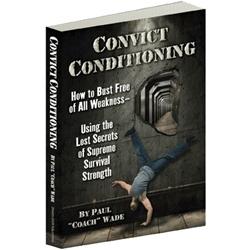
Behind the 8 Ball a Little but What the Hell: My Review of the Convict Conditioning Books

I've noticed that in the past few weeks, I've got some new readers. You may have found out about my blog from Paul Wade's newest book, "Convict Conditioning 2" where my super-sexy finger strength was on full display. So, that might color be as bias to others if I gave my dos centavos about the the series that I've given modest contribution to. If that's what you're thinking then FUCK YOU. I try to be honest and I wouldn't put myself in a book series if I felt that it was shit. I was very happy for the invitation to be in the book and I think both are awesome books.

It's always struck me as strange but as I've been approached about BW strength training, I've noted that people seem to break down into two dramatically different groups. First are those who don't strength train at all and couldn't do one rep of even the most basic pull-up and push-up so they don't bother since they're that weak. The next group are the people who looked at the basics as just that: basics. Once they got good at them they abandoned them for the weights since they figured that there was no worthwhile strength progression afterwards.


Convict Conditioning (CC1) is excellent because it covers both types of strength trainers with variations on six Bodyweight movements, ranging from very easy to very advanced. I'd go so far as to say that this is the best, pure BW book out there. If you had to buy just one BW book to get you started in BW training and sustain you with a very bare minimum of stuff for a few years, then this is the book to get. The most elaborate equipment in this book are baseballs, basketballs, and towels. The only references to weights I recall are car pushing, carrying another person, plates for twisting exercises, and using jugs of water for balance while doing pistols.

I'm sure that a lot of us (Paul Wade included) know the criticisms regarding CC1. Compared to something like Ross Enamait's masterpiece, "Never Gymless", CC1 is decidedly different. Much of the written material about strength training are about training for the sake of becoming stronger at some sort of sport (in Ross' case, it's boxing). CC1 is about learning to use and become stronger with BW movements rather than simply becoming stronger soley for bettering another activity.

There may be some people underwhelmed by the first book because more than half of the movements in CC1 are child's play to them. If that's you, then Convict Conditioning 2(CC2) is your book. There are no basic or beginners moves here. There are simply beginner moves to some very difficult exercises. A lot of people complain about buying books about BW since the written know-how can be found on the internet with a couple of key strokes on Google. Indeed, I've seen plenty of tutorials on pistols and pull-ups. Ah wheel roll-out are down to a nickel a dozen. Flag holds are much more rare and not nearly as well-taught as it is in this book. As before in CC1, the progressions are laid out very clearly and logically. If you thought that the layout of progression in CC1 was awesome in it's simple brutality, then you won't be disappointed with CC2.

It also touches on other topics beyond the argument for BW training and the moves not that he didn't bring up in CC1. There's discussions on nutrition, active stretching, keeping your joints in running order, getting the mind right and clean living. This gives the book a more vintage feel, sort of like reading, "The Way to Live" by George Hackenschmidt.

Once again, very minimum amount of equipment is used in any of these exercises. In my opinion, the genius of both books is that it shows you the dizzying levels of physical power you can really generate with such a bare-bones setting! The books cost a little more than most other books on the subject but if you want to measure the price up to what you can do with the information contained within, these books earn their keep.

In other words, I highly recommend them.